
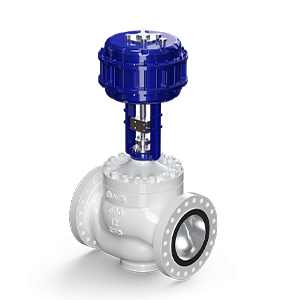
CN702 Low-noise Cage-guided Control Valve
The CN702 Low-noise Cage-guided Control Valve is mainly designed to reduce the noise of compressible fluids. To accommodate gas throttling, diffusion and expansion, many symmetrical small holes are provided on the sleeve to reduce pressure drop. It is widely used in self-control systems of industries such as petroleum, chemical engineering, metallurgy, power stations, air separation equipment, liquefied natural gas, etc. The fluid channel is in an S-flow pattern, and there is also a guide wing to improve the smooth flow of the fluid around the sleeve. Therefore, the regulating valve has low pressure drop loss, large flow rate, low noise and less cavitation corrosion.
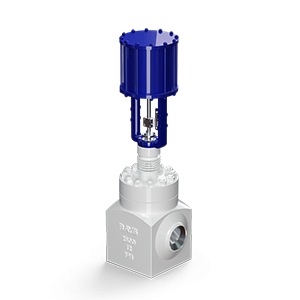
CDN702 High Differential Pressure, Low-noise, High Stability Cage-guided Control Valve
The CDN702 High Differential Pressure, Low-noise, High Stability Cage-guided Control Valve is mainly designed to reduce the noise of compressible fluids and ensure the stability of the valve under high-pressure difference conditions. To accommodate gas throttling, diffusion and expansion, the sleeve is equipped with multiple pairs of symmetrical holes to reduce pressure drop. It is suitable for use in high-pressure difference process pipeline control conditions. The fluid channel is in the shape of an S-flow line, and it also has a guide wing to improve the balanced flow of the fluid around the sleeve and a dual-directional structure to ensure stability. The valve core adopts a force balance structure that achieves high-pressure difference control with a smaller operating output force in terms of structure.
The C700 Series Low-Noise Control Valve is divided into the CN702 and CDN702 series, mainly designed to reduce the noise of compressible fluids. To adapt to the throttling, diffusion and expansion of gases, the valve core adopts a pressure-balanced structure, and the sleeve is equipped with many symmetrical small holes to reduce pressure drop. The fluid passage is in an S-shaped streamline, and a deflector wing is also provided to improve the smooth flow of the fluid around the sleeve. Therefore, the control valve has low pressure drop loss, large flow rate, low noise and less cavitation corrosion. The control valve is equipped with the RSMF series multi-spring pneumatic diaphragm actuator, which has a simple and compact structure, stronger stability, large output force and long service life.
This series of regulating valves employ multi-stage valve cores and porous structures to gradually reduce the flow velocity of the fluid, disperse energy, and minimize turbulence and cavitation phenomena. As a result, the noise can be significantly reduced (typically by 20-40 dB). The flow characteristics are linear or equal percentage, ensuring good linearity of flow regulation and enabling precise control of the fluid. The pneumatic low-noise regulating valve not only guarantees the accuracy of process control but also effectively improves the working environment, meeting the dual demands of modern industry for environmental protection and efficient production.
Material: WCB、WCC、LCB、LCC、WC6、WC9、CF8、CF8M、CF3、CF3M....
Nominal Size: DN25~700 NPS 1”~28”
Pressure Rate: PN16、PN25、PN40、PN63、PN100、CL150、CL300、CL600
High Pressure:CL900 、CL1500 、CL2500
Temperature Range: Normal temperature type P: -17℃ to +230℃
High-temperature type EI: +230℃ to +525℃
Low-temperature type LE-I: -45℃ to -17℃ LE-II:-100℃~-45℃
LE-III:-196℃~-100℃
Operator: Pneumatic, electric, manual, pneumohydraulic linkage, electro-hydraulic linkage and other types.
Application range: Suitable for precise regulation and effective control of fluid flow, pressure, temperature or liquid level in pipeline systems of water supply, petrochemical, metallurgy, mining, light textile, energy, papermaking, food, steel and other industries.